
Civil Projects in Bangalore — Final Year Engineering Projects
Structural models, material studies and smart infrastructure — physically tested.
12 project titles — click to expand.
Download Civil Project List (PDF)A wireless sensor network installed on a 1:20 scale bridge model, measuring strain, deflection and vibration under controlled loading. STM32-based nodes transmit data via LoRa to a gateway, and a Python dashboard visualises real-time structural response and flags anomalies against a FEM baseline model built in ANSYS.
// CORE TECHNOLOGIES
// WHAT YOU GET
- Working hardware/software demo
- Full source code
- Circuit diagrams & schematics
- Bill of Materials (BOM)
- Project report material
- PPT support
- Viva walkthrough session
A comparative material study evaluating crack-healing efficiency in concrete specimens incorporating three healing agents: encapsulated sodium silicate, Bacillus subtilis bacterial spores, and polyurethane microcapsules. Crack width, compressive strength recovery and water permeability are measured at 7, 14 and 28 days post-cracking.
// CORE TECHNOLOGIES
// WHAT YOU GET
- Working hardware/software demo
- Full source code
- Circuit diagrams & schematics
- Bill of Materials (BOM)
- Project report material
- PPT support
- Viva walkthrough session
A spatial analysis workflow in QGIS that integrates DEM data, land use classification, drainage network topology and historical rainfall records to produce a multi-tier flood hazard map for a selected urban catchment. Sensitivity analysis quantifies how a 20% increase in imperviousness changes the 100-year flood extent.
// CORE TECHNOLOGIES
// WHAT YOU GET
- Working hardware/software demo
- Full source code
- Circuit diagrams & schematics
- Bill of Materials (BOM)
- Project report material
- PPT support
- Viva walkthrough session
An experimental investigation into the effect of shredded LDPE plastic waste on the Marshall stability and flow properties of bituminous concrete mixes. Mix designs with 0%, 4%, 8% and 12% plastic content by weight of bitumen are prepared, compacted and tested, with results compared against VG-30 control mix benchmarks.
// CORE TECHNOLOGIES
// WHAT YOU GET
- Working hardware/software demo
- Full source code
- Circuit diagrams & schematics
- Bill of Materials (BOM)
- Project report material
- PPT support
- Viva walkthrough session
A site-specific water balance model for a 5,000m² commercial building rooftop catchment that optimises cistern sizing to maximise supply reliability across Bengaluru's bimodal monsoon pattern. The model outputs a demand-reliability curve and a 20-year NPV analysis comparing harvesting against municipal supply costs.
// CORE TECHNOLOGIES
// WHAT YOU GET
- Working hardware/software demo
- Full source code
- Circuit diagrams & schematics
- Bill of Materials (BOM)
- Project report material
- PPT support
- Viva walkthrough session
A full Building Information Model of a G+3 residential structure in Revit, linked to a quantity take-off schedule and a project timeline in MS Project to produce a 5D model that dynamically updates cost estimates when design parameters change. Clash detection reports and construction phasing animations are included in the deliverable.
// CORE TECHNOLOGIES
// WHAT YOU GET
- Working hardware/software demo
- Full source code
- Circuit diagrams & schematics
- Bill of Materials (BOM)
- Project report material
- PPT support
- Viva walkthrough session
An underground mine safety system using MQ-series gas sensors (CO, CH4, H2S) and particulate sensors mounted on a ruggedised ESP32 node, with a LoRa uplink to a surface control room. The system triggers zone-specific audio/visual alarms and sends SMS alerts when gas concentrations exceed DGMS threshold limits.
// CORE TECHNOLOGIES
// WHAT YOU GET
- Working hardware/software demo
- Full source code
- Circuit diagrams & schematics
- Bill of Materials (BOM)
- Project report material
- PPT support
- Viva walkthrough session
A laboratory investigation into the stabilisation of expansive black cotton soil using combinations of fly ash, GGBS and lime at varying percentages. CBR, UCS, Atterberg limits and swell pressure are measured for each combination, establishing the optimal blend for sub-grade stabilisation in Karnataka road construction.
// CORE TECHNOLOGIES
// WHAT YOU GET
- Working hardware/software demo
- Full source code
- Circuit diagrams & schematics
- Bill of Materials (BOM)
- Project report material
- PPT support
- Viva walkthrough session
A comparative finite element study in ETABS analysing the seismic performance of a G+10 RC frame building with three shear wall configurations (core wall, coupled wall, perimeter wall) under IS 1893 Zone III ground motion. Storey drift, base shear and ductility demand are compared across configurations.
// CORE TECHNOLOGIES
// WHAT YOU GET
- Working hardware/software demo
- Full source code
- Circuit diagrams & schematics
- Bill of Materials (BOM)
- Project report material
- PPT support
- Viva walkthrough session
An IoT-instrumented scale model of a water distribution network with pressure transducers and flow meters at six nodes, an ESP32 controller managing pump speed via VFD, and a SCADA interface that detects pipe burst events from pressure signature anomalies and isolates the affected zone within 3 seconds.
// CORE TECHNOLOGIES
// WHAT YOU GET
- Working hardware/software demo
- Full source code
- Circuit diagrams & schematics
- Bill of Materials (BOM)
- Project report material
- PPT support
- Viva walkthrough session
A mix design investigation into pervious concrete using single-sized 10mm and 20mm aggregates with water-cement ratios of 0.30–0.38, measuring permeability coefficient, compressive strength and void ratio for each combination. Results are mapped against ASTM C1701 targets for stormwater infiltration applications.
// CORE TECHNOLOGIES
// WHAT YOU GET
- Working hardware/software demo
- Full source code
- Circuit diagrams & schematics
- Bill of Materials (BOM)
- Project report material
- PPT support
- Viva walkthrough session
A video-based traffic survey system using a fixed camera and a YOLO v8 object detection model to automatically classify and count vehicles by type (2W, 3W, car, LCV, HCV, bus) at a selected intersection. PCU-weighted flow rates are computed and compared with manual classified counts to validate the automated method.
// CORE TECHNOLOGIES
// WHAT YOU GET
- Working hardware/software demo
- Full source code
- Circuit diagrams & schematics
- Bill of Materials (BOM)
- Project report material
- PPT support
- Viva walkthrough session
// POPULAR CIVIL PROJECT CATEGORIES IN BANGALORE
Have your own idea?
Bring the concept. We do the feasibility check and build it if it's achievable in your timeline.
Looking for a mini project instead? We build affordable mini projects for 1st–6th semester students across all branches.
Browse Mini Projects →Questions we get asked every week.
Can you build physical scale models for civil projects?
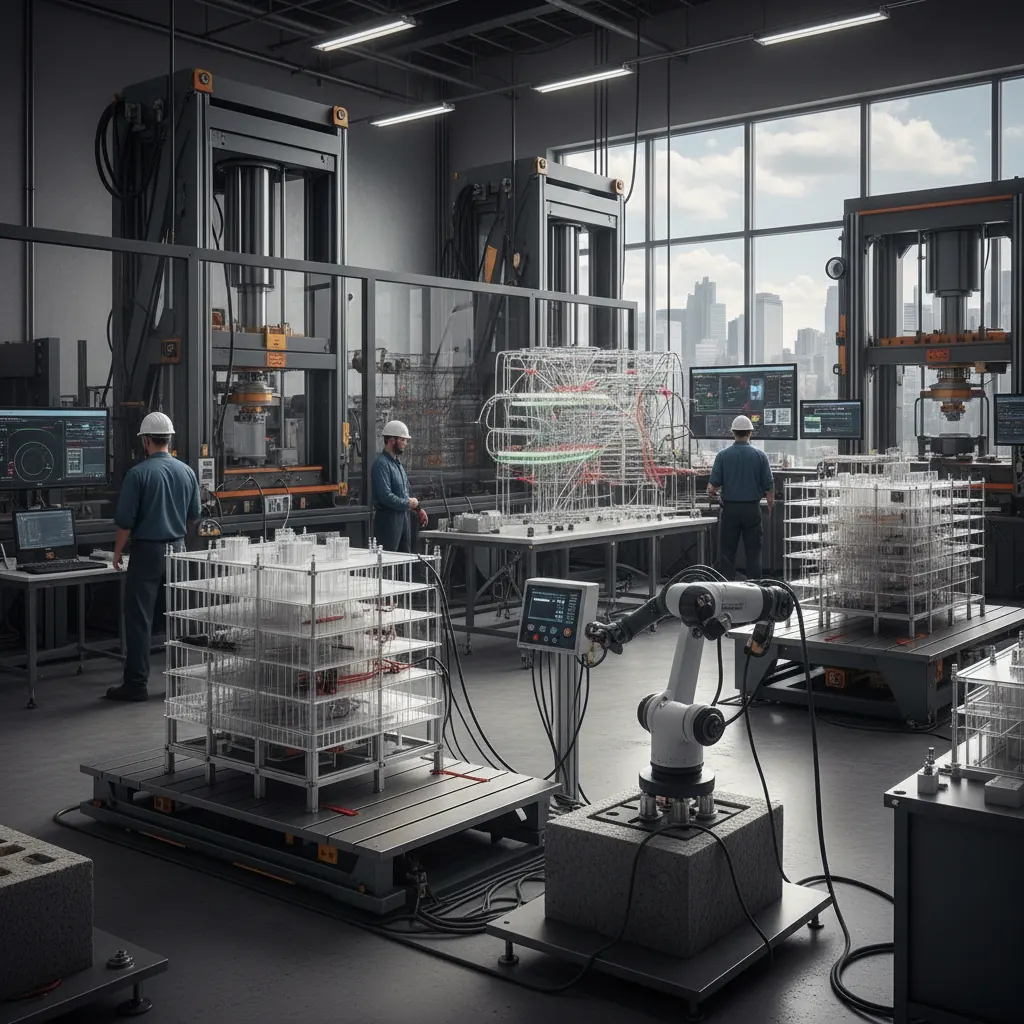
Yes. Structural models, formwork systems and soil test rigs are fabricated in our lab. We also instrument them with load cells, strain gauges and displacement sensors for quantitative testing.
Do you support GIS and remote sensing projects?
Yes. We work with QGIS, ArcGIS, Google Earth Engine and drone-captured orthophotos for mapping, flood risk analysis and land use projects.
Can mining projects include sensor-based safety systems?
Yes. Gas detection, vibration monitoring and emergency alert systems with embedded electronics are within scope — we have both the civil knowledge and the electronics fabrication capability in-house.